Wednesday Wisdom: Sensibility

Trigger Warning: Content contains sexual violence/trauma

The author Jessica Stern has been a huge influence on my writing work. She has written many books on terrorism (which I have not read, sorry, Jessica), but her memoir continues to inspire me with a single line. She wrote, “This is the worst impact of severe trauma: the victim loses faith in the evidence of her own senses.”

When I read this, I practically lifted my butt out of the chair with elation. Somebody finally understood me!

My story is not Jessica’s. Her memoir, Denial, A Memoir of Terror, reveals her journey as an expert on terrorism and her resilience to fear despite the extremely dangerous situations she willingly immersed herself in. Her investigative questioning to understand this resilience lead her back to her teen years when she and her sister were violently raped in their childhood home. As an emotional response to endure the incident, young Jessica willed away her fear. Afterwards, there was no memory of the event, as the trauma blocked her perception from her reality. She went on to live with a depleted sense of fear, which would explain her later obsession with danger. She wanted to feel something.

Trauma robs our perception of reality. This manifests in normalizing abnormal situations/behavior that we would typically avoid. The emotional wall meant to protect us has taken over, and rises each time the behavior occurs. We see it often in others, but it is much harder to see in ourselves as we have adapted to our own devices of self-protection. For whatever reason, this is a concept I continually obsess over and find absolutely fascinating. My own memoir delves into this notion, and whereas I have no expertise in the neurological manifestation of denial, I get it. I understand how emotions can be erased.

The way back to sensibility is through honesty, scrutiny, and one of the toughest jobs of adulting, emotional inquiry. We cannot arrive on the other side of trauma without the detective work into our own pasts. This requires guidance, support, a tribe, a community, an expert on trauma, loads of self-care, and absolute and endless loyalty to ourselves. It is not easy work, but when we regain our sensibility, we repair the broken link to the fullness of our identity.

Know that wherever you are in the journey, you are not alone. There is great power in each of us to immerse in healing, and many sources and methods exist for support. I like to think of myself as a friendly delegate. I’m happy to share links I have found helpful. Please email me if this interests you. Most of all, be kind and love yourself. You are so worthy of love.

Wednesday Wisdom: Patterns

Language learning in children is an exercise in reciting patterns. Initiating the sequence of knowledge begins with counting from one to ten, the days of the week, the months of the year, and grows with conceptual associations in and out of the classroom. Each step is a launch forward in learning a larger scope of the world.

We humans learn emotions in much the same way but without the classic structure of instruction. Our childhood emotional education is a process of discovery, blindly steeped in the world at home before our interactions with others. Many sad tears of mine were a result of new insults or new defenses that would not go unpunished. Despite my efforts to connect or protect, I was taking steps toward learned behavior.

When we enter adulthood, we have unconsciously adapted to the emotional instruction as a norm, but fortitude comes when we question these beliefs. Not everything we learned was for our benefit. As adults, it is imperative that we become adept at noticing our emotional patterns because it is in repetition where we find our contributions to the situations we are immersed in. Emotional health, often closely-related to physical wellness, relies on the need for positive reciprocity in our relationships. If you’re uncertain about a difficult relationship, keep in mind that every abuse is a pattern. Does that feeling arise again and again? Take notes on how, why, when. Soon, you will see the repetition.

Emotions leave scars, left by insensitive or wounded hearts who would not see their own power. Life is not perfect. When we take the role of observer in our emotional patterns, we more acutely see each glitch and the behavior on the other end. Abuse is often hard to detect when it has been normalized in our lives, unless we prioritize our own emotional safety and implement a system of documentation. Guilt can prevent us from establishing boundaries in toxic relationships, but it is empowering if you think of it as confronting behavior. Changes in pattern will diminish your fear, anger, and shame, and grant space in your life for beauty.

We can create a more harmonious world for ourselves. Healing has allowed me to choose the patterns that sustain me, to fill my life with the beautiful repetition of sounds I love to hear: a friend’s inimitable laughter, my husband pouring me a glass of wine and talking about our day, my daughters’ voices, the keyboard as I process my own thoughts to understand who I am on this journey. In filling my life with the patterns that reinvest in my worth, I am able to launch myself further into the scope of what lies ahead.

Just like children, the discoveries of our past can shape our future. You are never too old, too unskilled, too reliant on another (financially or otherwise) to neglect defending your emotional needs. The courage to make the leap is not only a step away from fear and shame, but also a step toward the scope of you. You are worth so much more than pain.

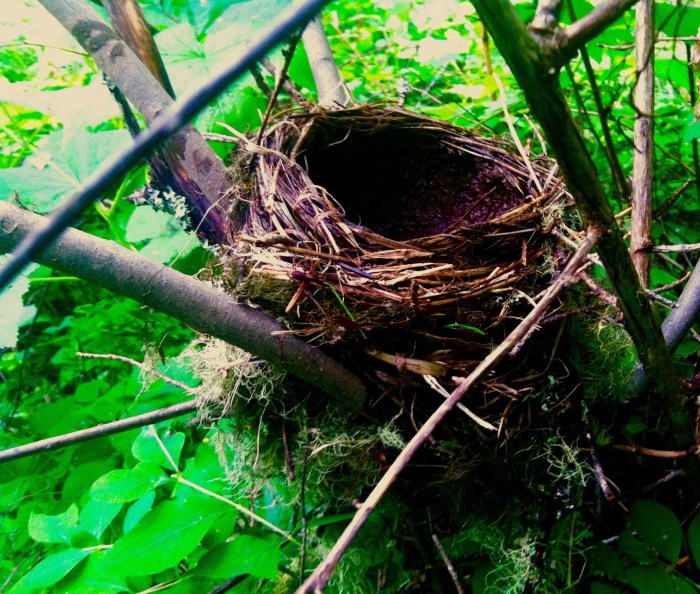
An empty robin’s nest will be repurposed the following spring.