Wednesday Wisdom: Writing

This past weekend, I attended AWP (Association of Writers and Writing Programs) in Portland. With 12,000 participants, it was its own city of writers, editors, and agents communed within the walls of the Oregon Convention Center. Long lines for coffee and food trailed into the passageways. People sat on the floor for the one-hour-and-fifteen-minute panels that dealt with every aspect of writing from censorship to the struggle of finding the story and the dreaded heartbeat of every writer: searching for the right word. One message repeated itself over and over. Writing is hard.

Although, technically it isn’t. The act of writing is simple. You put your hand to the keyboard or pen and release words across the page. Why is it so difficult, then? The constraints writers face make writing hard. Every time a writer puts her opinions and creativity into the world, she faces her fears of rejection, judgment, and shame. She tosses aside the current flow of pedestrian life and dares to counter the socialized manner of thinking. She is an outcast.

Why bother? Because it is a must. At an early age, something told her she would be a writer. She read a book that changed her life. Or she lived through something horrible that she wants to prevent from happening again and again and again to innocent girls. A writer seeks amelioration.

The page offers a voice. Humanity is brutal in its censorship of the world beyond the privileged status of white men. It squelches many voices, especially the wounded. It silences a girl from announcing her identity, her sexuality, her worth, by not only dismissing her opinions, but her cries to the abuser to just stop. Now.

We convened under one roof, these girls and women, boys and men, and everyone in-between who have experienced the trivializing and traumatizing impact of shame. We united in one force of commonality: the quest for resurrection.

Writing is hard because we fail to believe we deserve the right to own our ideas. It is hard because we believe our efforts are futile, that we have nothing of value to offer, that we are so small nobody will hear us anyway. This is what we’ve been told, and the story we have once told ourselves.

En masse, we were not small. 12,000 writers dared to believe in the power of story. We communed with an internal drive to create a narrative, sometimes fiction, sometimes true, of human conflict, rife with struggle and compassion, torture and resurgence, grief, and a hard-won lesson of perseverance.

Stories fight the internal whisper of worthlessness and shame. Well-known authors took to the stage to uplift and encourage, to reaffirm that the struggle of voice is real. The unspoken message echoed through the walls and beneath the footsteps that raced from room to room, validating the power of every pen in the building. Keep going, it said. We were there. We are here.

With you.

You have permission to voice your struggles and to author your own life. The story you were told is not the story you need to believe. It begins with a word, not on the page, but in the core of your heart. Love. Honor. Cherish. Choose one word. You are not alone.

Ritzville, Washington on the drive home from AWP.

Wednesday Wisdom: Honor

Nobody has to be important or beautiful to hold significance in the world. We are only as good to others as we are to ourselves. Honor your unique gifts with courage.

A merlin, a rare type of falcon, perched on a tree. (Photo taken by moi )

Here’s an interesting way to honor household objects. The Domestic Apologies

Next week, there will not be a Wednesday Wisdom post. I’ll be in Portland attending AWP (Association of Writers and Writing Programs), connecting with my tribe.

Love to all of you, Barbie

Wednesday Wisdom: Validation

“What do you feel when you’ve been hit by a car?”

This question was posed to my Developmental Psychology class (years ago) by the professor, a short and stout man with salt and pepper hair and a white beard.

The class had various responses. “Pain.” “A thud.” “Pissed off.”

The professor said, “Anger, right? Your heart races and you want to beat the pulp out of whoever drove into you.”

He probed the class with more questions. “Why do you feel angry?”

Again, the class had answers ranging from ‘Because it’s expensive’ to ‘Because it’s not fair’.

“Yes, those are right, but also because it invades your space, right? You’re driving along, and WHAM! Someone who isn’t supposed to be there crashes into you. It betrays your sense of space. It betrays your sense of security. ”

We know anger, the brain’s response to threat. The heat turns up, our heart rate increases, voices grow louder or shakier, veins bulge. We sense that our security is at risk. As with a car wreck, we experience the same response when emotional events leave us feeling angry, shaken, and often times, distraught, but the betrayal is personal when we feel unworthy of a significant person’s consideration or empathy.

Lack of emotional validation, a component of emotional neglect, comes in many forms: stonewalling, trivializing, avoidance, and, table-turning, such as, “You’re too sensitive.” For behavior to be abusive, it repeats itself over and over, a pattern in daily life. Our security is stolen by words.

As far as the brain is concerned, emotional abuse has the same impact as physical abuse. Over time, it damages developing brains, destroys trust, corrodes self-esteem. Ego is at the core of every abuse, and between abuser and victim it is either empowered or denied, entitled or diminished. The danger of emotional neglect is its invisibility, allowing it to continue for years and years undetected, worsening the impact over time.

My life is made meaningful by bringing awareness to the invisible epidemic that shattered me. It was a series of car wrecks, small, but frequent, that went on for years before I was able to recognize its manifestation as a huge barrier on my self-worth and well-being. Over 10% of adults claim to have been emotionally abused as children, but this number only represents reported cases.* No child should ever feel insignificant, unworthy of love, or inferior in their own home. If you have been feeling alone and ashamed for years, told that your emotional ‘choices’ are wrong, or uncertain about who to trust, you aren’t alone.

The roadmap to how we perceive the world, emotions are the core of our identities, and everyone deserves emotional agency without shame or guilt. Emotions are never wrong, in fact, they are unique to our experience and guide us to the person we are meant to be. When we recognize behavior that removes us from the center of our experience and makes it about somebody else, we can begin to correct the contributions that perpetuate the unhealthy relationship. Invisible abuses thrive in complacency. There is redemption in the fact that compassion is free—emotional validation costs nothing to give.

When we enact on goodness, we mirror the good of the world. Each of us is allowed to be the driver of our life and it is never too early, or too late, to expect kindness. There is plenty of space to be yourself. It’s a good idea to ask, “Who validates me?”

*Statistic from Child Help. For more information, see childhelp.org

Wednesday Wisdom: Ash Wednesday

Today is Ash Wednesday, the beginning of Lent, the season of giving up or reducing indulgences that hinder our lives of faith. As an adult convert to Catholicism, I have not once successfully committed to the full length of forty days from abstaining from things that make me, Catholically speaking, a worse person.

Typically, I go the wellness route. One year, I committed to drinking plenty of water. Another year, I committed to less yelling. One year, more recent than the others, I committed to the grace of mercy by forgiving those who have wronged me in the past.

The French word for ‘thank you’, merci, is a daily implementation of mercy. Gratitude is a practice of acknowledging the gift of others. The gift of others. The practice of mercy untethered me from a victim mindset to one of growth. Even pain, and in my case, trauma and PTSD, was a gift of others. Suffering is usually not a human condition one enters into by themselves, and only our most-whole selves can begin to understand the gift, the transference, of another’s pain.

For my Self to feel whole, I had to practice mercy on myself. Forgiving my past failures and fears was much harder for me than forgiving others. Learning to treat myself equally, to not be my own victim, was a step that allowed me to face life’s uncertainty with the dignity that I deserved. Mercy doesn’t seek revenge or tolerate injustice. It’s a fortitude that allows the dissolution of control. When we let the nature of things go where they will, when we stop trying to counter the force of the hurricane, we are rewarded with nature’s inclination for balance.

By practicing mercy in the world, the opportunity for gratitude grew stronger which allowed me to feel less concerned about being wronged or shortchanged. Somewhere in my childhood, the notion that everything was supposed to be idyllic and perfect set a high standard, somewhere near the mark of 100%. It took me many years into adulthood to recognize this ideal was unnecessary, and quite frankly, impossible. My happiness is quite full, even at the 75% mark. For that, I am grateful.

For me, Lent is not just a period of deprivation, but a time for reflection. We are all shortchanged in life, but the lack doesn’t correlate with our worth. Digging deep to a place of forgiveness and mercy is an act of integrity and compassion. The world could use more of that.

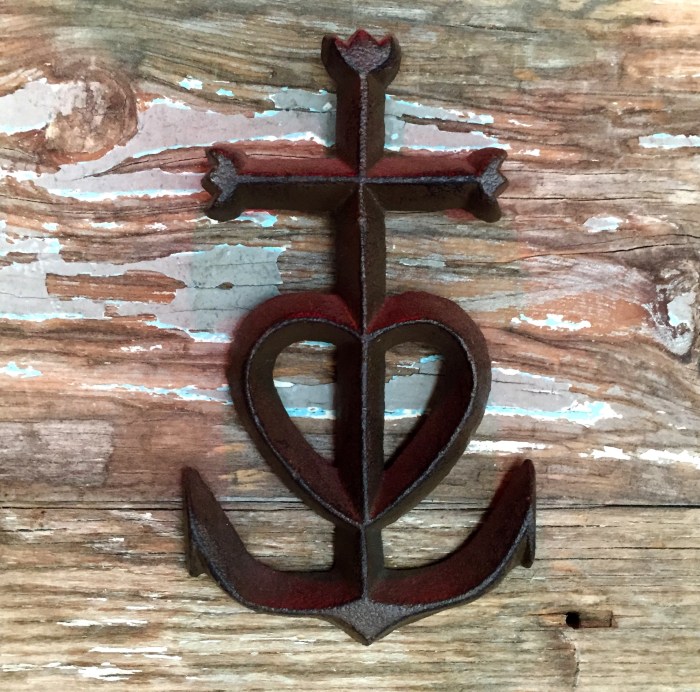
Faith, love, and hope symbolized on a maritime cross from St. Marie de la Mer, France

Wednesday Wisdom: Doubt

The snow is still falling here in Montana. When I look outside, a yellow patio table beams like sunlight against the white-washed everything, a beacon of hope for spring, although it seems like it may take forever before we are rewarded with a hint of green.

My brain feels snowy these days, overwhelmed by the singular vision of commitment that a book-length project can bring. On Monday, I submitted a short memoir piece to Creative Nonfiction magazine for a contest with the hope that working on a new story would have inspired me with vigor. I do not expect to win. It was a goal I set in January, and I am learning how hard I am to myself when I let myself down.

Writing nonfiction brings me to desolate places. I wonder if I will ever finish my memoir, if I’m creating a cohesive narrative, if my story will resonate with the right readers, or if it will have any readers at all. Doubt is a nightly snowfall to clear away in the daylight, because underneath doubt is a narrative that brings hope to the world. Every person has a story worth telling, a life worth sharing, and withholding the hardest stories cheats the world from the truth.

At the Oscars on Sunday night, Samuel L. Jackson said, “The easiest thing to do in the world is to not write.”

This off-hand comment was the wisdom I needed to hear. Doubt was given to me by voices who didn’t agree with my message, who thought my pain should be stifled, that my voice should be silenced, that my worth shifted on a scale of obedience. Doubt was given to me by myself when I diminished my self-worth enough to believe them.

Silence is the snowfall that allows the perpetuity of abuses in relationships and society. Writing is only one of the numerous means to declare power where voice was stolen and dignity denied. I write to dispel the shame of those who seek only their humanity in a world that forbids it. Emotions are not weakness—they are fire. Sitting at my computer, when I gaze outside, I can’t help but think what a beautiful time it is to be alive.