Wednesday Wisdom

Wednesdays are complicated. Like a riddle, the spelling of the word itself doesn’t represent its sound. Positioned in the middle of the work week, Wednesdays bring us to a point of transformation from beginning to end, looking both at a time past and to the hopeful promise of freedom ahead.

I’m a woman in the middle of my life. I, too, am complicated. Born the second of three daughters, I’m a middle child who has transformed from the insecurity of my past and who now faces a future free from life’s fallacies. I identify with Wednesdays, with the middle, because like a game of tug-of-war this is where we find tension. With truth, we can change course in our life, and the middle is both uphill and downhill, effort before glide.

Life is much easier without fallacies. For forty-two years, I created an illusion of the family I wanted, overlooking the evidences of something amiss. Society tells us that good girls are nice girls, but I was cruel to myself for believing that I had no voice to use to defend myself, that I must say yes to every demand, that I must always, always put others first.

It didn’t work. Trauma was my blessing. It illuminated the trap of womanhood passed through generations of family trauma and a society who seeks to silence women. Until I faced my fears, it was disguised as my inherent weakness, as my fault, as the problem of the middle child.

Beauty comes from life’s disasters. I believe in the virtue of every person who aches inside for truth. It will come, I want to say, as soon as you allow it.

We all become trapped at one point or another: in fallacies, in ideals. Permission brings freedom. Allowing truth in my life catapulted me from a place of fear to healing, and my daughters now have a mother who models an authentic life. The truth of pain is excruciating and real, but emotions are our roadmap when we allow them space in reality instead of a made-up world. Strength lies in the truth-telling. When you trust your own version of the world over anyone else’s you can discern the entrapments that fail to serve you, and you will march onward because at this point on your climb to freedom, you have made it half-way.

New Feature: Wednesday Wisdom

Hi Friends,

I’ve implemented a new feature on my blog, a weekly post titled Wednesday Wisdom. It is a brief, random writing of my thoughts about empowerment. I am hoping to engage many people, especially women, in the conversation we need in society about allowing emotions to be taken seriously. Our voice is the impetus for change in our lives. This is a broad topic, one that I believe in and am passionate about. It starts with admitting any denial you might be afraid to admit, but freedom releases us from fear and brings us healing. Giving ourselves permission is easiest with company. I believe in you!

The first post will be sent to your inbox tomorrow. Thank you for letting me share with you.

Barbie

Fall Happenings

I wasn’t going to submit the application. One part of me felt hopeless about making the cut for a fall residency at Virginia Center for the Creative Arts (VCCA). Because I had only one published work, I filled a pithy resumé of writing classes I had taken, most of them online, for the goal of writing my memoir.

On the day of the deadline, a notification sidled into view on the screen telling me I had three extra days to finish the application. I groaned. This meant compiling twenty-five pages of work and finding two nice people to send a letter of reference on my behalf.

Weeks later, I was accepted into VCCA. Not only was I fraught with tears because of the unlikelihood of being accepted, but my submission was chosen for an honorary  fellowship. Every year, one person from Montana is awarded a free residency at VCCA. Out of our huge state, I am that one.

I’ll be heading to Virginia in November for two and a half weeks. There, I don’t need to cook, or walk the dog, or do the family laundry, or shower. OK, I will do that, but the rest of the time I will write.

The validation comes in the form of knowing my story meant something to someone I have never met. Although it was a cobbled together sample, my excerpt spanned the years from childhood to adulthood. The writer hovers over a younger version of herself, watching as a girl overcomes fears, speaking words once blinded by innocence with a deeper perspective. One who sees not just a sheet of stars in the sky, but thick layers of them, heaped like the matter of a cellular body.

This fall, I will also be reading from my first publication during the Montana Book Festival. The lyric essay, Small Towns, published in Bright Bones: Contemporary Montana Writing suggests the importance of crossing from one place to the next. There is some irony there, as my writing launches me into the next phase, from isolation to a sharing of long-held secrets.

I’m hoping to grow gracefully in this new space. There is room for everyone in the creative world. I hope to find you there.


SCHOOLED LIVES: TERROR AND FEAR

GROWING UP, I ATTENDED A SMALL RURAL SCHOOL in Marion, Montana. In 2010, the town’s total population reached 886, a number assumedly greater than it had been in the late 70’s and early 80’s when I was a dreamily imaginative elementary student.

My family had moved from upstate New York—I started as a second grader. The school building took its aesthetic from the past: white clapboard siding of a symmetrical rectangular shape topped with a bell tower. The only outstanding element was the interior where book-filled shelves surrounded the small classrooms like moats. As a new student, I was comforted by the smell of dust and paper and old wood. Mr. Holmquist, my first male teacher, stood at the chalkboard like the Jolly Green Giant, though his color softened beneath red hair, freckles, and polyester pants of baby blue. His stature frightened me. At nearly seven years old, everything about me was small and tentative. Too afraid to ask him if I could use the bathroom, I peed my pants at my desk, sitting in a listless curve while subsequent laughter and jeering from classmates found its way to my ego.

The Wild West conjured images of cowboys with bandanas. Forget cowboy hats. A bandana tied around the neck was a detail of protection, a shield, the thin cotton utilized as sunscreen and probably little else. In my seven-year old girl mind, I thought it was a statement, the marking of a male ego not afraid of vulnerability. A bandana was equivalent to a pair of earrings, a decorous item to fancy up the complete image, and because of this outward display of unabashed femininity, I looked up to cowboys.

The books on the shelves were old, most likely hand-me-downs from other schools or libraries in the county or state. Like many small towns, information was outdated. Without knowing it, I lived in a sphere of removal but the books provided me with a world of intrigue and expansion. By third grade, I had become friends with categories of books bearing titles such as Flutterby and Hucklebug, the illustrations a spark to my imaginative mind and belief in mythical existences. Immersed in the beauty of nature, I grew into the idea of wild security, a sense of safety within the landscape of unlimited threat.

I didn’t know terror. The recent school shooting in Florida, leaving seventeen dead and countless lives shattered, has impaled me with yet another white-knuckled grip on the handle of grief. As our country mourns the vulnerable, I can’t help but notice the stages of trauma played out on media platforms. There is anger. There is blame. The hurt we feel is expressed in outbursts of rage and confusion, a normal response to existing in a state of unending pain. We don’t feel safe.

I can’t help but wonder how this same landscape played in the mind of the shooter. Ordinary people don’t kill other people. To say this person is unlike us is to acknowledge his vulnerability in a world of unlimited threat. I don’t want to continue this concept any further, I only want to place reality onto a situation of mythical proportion.

I won’t pretend to have grown-up solutions, but to offer my thoughts on the root details. The pattern of violence is also a pattern of fear, an emotion I know and understand to fall within the normal experience of humanity. I hope we can agree that security is, in its absolute reality, a thin veil, conceptually beautiful but elusive in performance. Shields are fallible. Our world, our landscape, is a struggle for survival, and we are a part of the greater wild, our children the most vulnerable of all. The shooter, too, was once a child. Somewhere in that time span he probably learned isolation. At home or at school, children fall into tactics that offer security from the stature the world has over them. It only makes sense that our obligation is to collectively care for all children, because every child deserves to believe in something beautiful.

My imaginative self sees a safe harbor for children in the unity of spirit. I am willing to set aside my anger and grief in the hope of connecting through courage. I am no longer afraid of vulnerability, but afraid of its absence. There are no walls in this world, only a belief that together we can replicate a sense of wild security. We must open the books that expand our worldview, take in the beauty, embrace the difference. In deliberate smallness, we can grow ourselves to believe beyond fear.
A Year of Writing

When I was a little girl, the humid, bitter cold of Lake Erie winters rattled in my lungs. Every year, I wheezed, gasped, and fevered my way through bouts of colds, flus, chicken pox, or some other childhood rite-of-passage illness. Once, flu and pneumonia compounded into a three-week hiatus from school. I was six years old. At its onset, I negated the cold outside with a fever so hot that I felt like I could toast bread by placing it on the skin above my ribs. Of course, I would have been unable to eat the toast. Nausea kept me from eating for weeks, and the ever-present thermometer hanging from my mouth obstructed the way.

When my mother came to read the lines where the mercury fell, I moaned, aching for comfort. “Why me,” I  asked.

These simple words were loaded. I fought my willingness to tackle the predicament not by wishing it onto someone else, but by wondering what I had done to deserve it, hoping for its course to run faster, doubting my strength to persevere. These concepts and my six-year old vocabulary didn’t align. I was, as we all are in youth, muted by age.

Forty years later, I can look back on the event and see its beauty. In the space between thought and words, a world of unknowns transpired. How did my mother feel? Why did I choose to say these words? Was I really aching for comfort, or was there something else, bigger, less immediate, that I needed? And it begs the question: Why do I choose to write about it?

If you want to burrow inside my brain, these types of questions circulate on an incessant track, day and night. I am plagued by curiosities, motivations intrigue me, and I am no longer mute. To uncover the possibilities of why I do what I do, I must write.


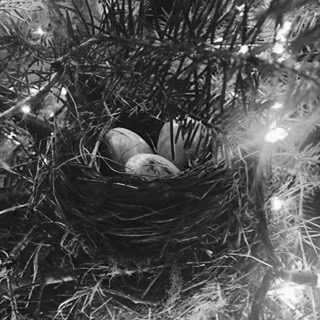
Christmas Nest
Christmas Tree with Nest


This past year of writing has brought me closer to my goal of finishing my childhood memoir, although it is nowhere close to where I would like it to be. Each scene, each description, is like one tiny line on the thermometer. A book-length work is comprised of these dashes, settling into place only after the fever burns. For my truth to manifest, I must get comfortable being uncomfortable, enduring each moment with hope that my words will truly express me, not my intentions, but my humanity.

I am persevering by letting go of doubt, the judge, the critic, that sits on the balcony of our life-stage and haggles us with inane commentary. The way I see it, the world is our critic. My only job is to continue the show, which I plan on doing when I send my messy manuscript to an editor in January. I trust her to take its temperature, read between the tiny lines, tell me where it runs hot or cold.

In the meantime, I can look back on the year’s progress with a sense of accomplishment. I’ve made some dashes, increased the mercurial importance of my story, settled into its heat. Despite the vast world of unknowns, I wrote. It’s warm in there. I think I’ll stay.